

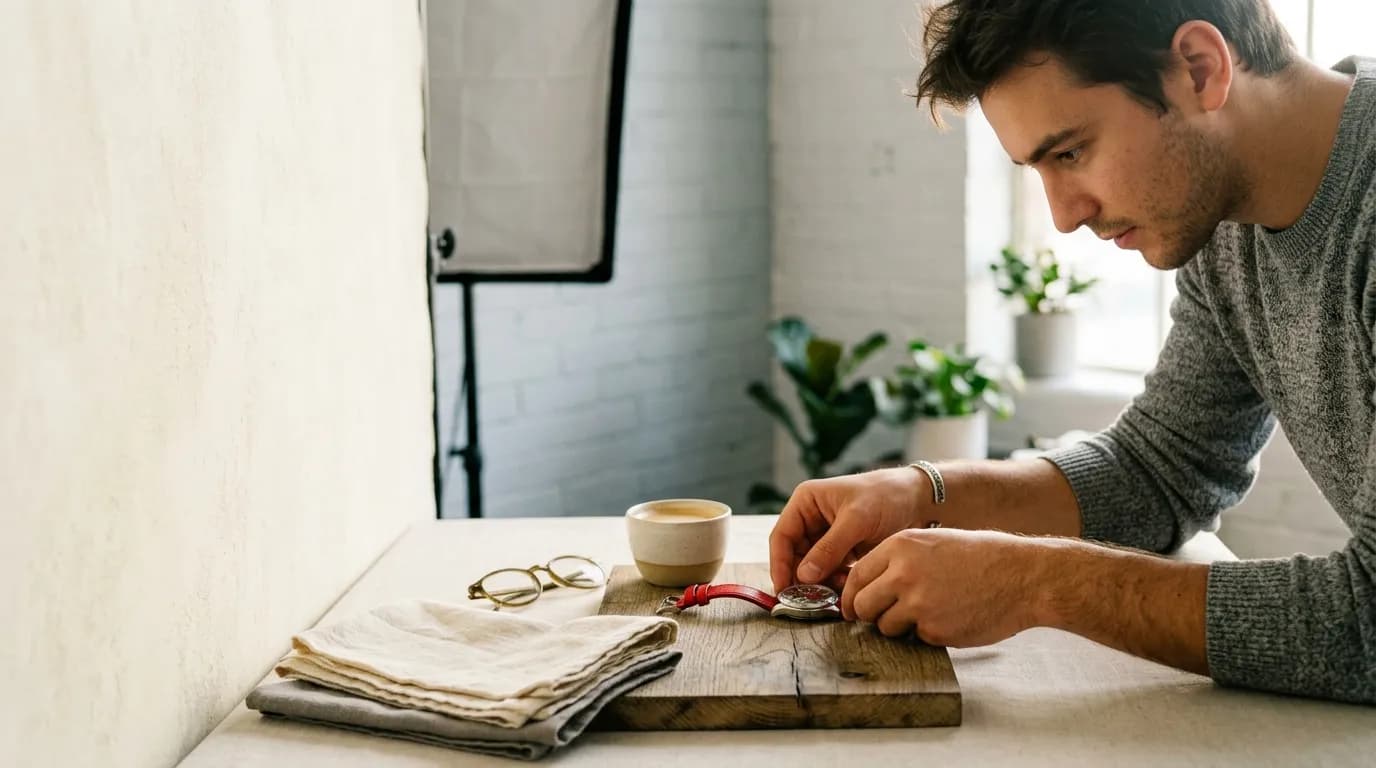
Most product shots fail for the same reason
Walk through any e-commerce site and you will see the same mistakes repeated: flat lighting that makes products look dull, awkward angles that hide the product's best features, and cluttered backgrounds that compete for attention. These images were not bad because the camera was cheap or the photographer was inexperienced. They were bad because nobody made intentional choices about composition.
Professional product photography is not about expensive equipment. It is about deliberate decisions. Every great product image starts with three questions: What angle shows this product best? What lighting makes it look most appealing? And what composition draws the viewer's eye exactly where you want it?
What professional photographers know that amateurs don't
Professional photographers spend years developing an intuition for what works. They know that a 45-degree angle creates depth and dimension for most products. They know that soft, diffused lighting eliminates harsh shadows and makes surfaces look clean. They know that negative space around a product makes it feel premium.
These are not artistic preferences. They are principles backed by decades of commercial photography experience. A food photographer knows that shooting slightly above and to the side makes dishes look appetizing. A jewelry photographer knows that directional lighting creates the sparkle that catches the eye. A furniture photographer knows that wide angles with leading lines make pieces feel inviting.
The gap between amateur and professional is not talent. It is accumulated knowledge about what specific choices produce what specific results.
Camera angles matter more than you think
The angle of your product shot communicates more than most people realize. A straight-on shot feels formal and informational, perfect for catalog listings. A slight downward angle feels accessible and friendly, ideal for lifestyle contexts. A low upward angle makes products feel powerful and aspirational.
Consider a simple coffee mug. Shot from directly above, it becomes a flat lay perfect for Instagram. Shot at eye level, it becomes a hero image for a homepage. Shot from slightly below with steam rising, it becomes an emotional lifestyle image that sells a feeling, not just a mug.
Professional photographers choose their angle based on the emotional response they want to create. They do not just point and shoot.
How AI replicates professional photography principles
The challenge with AI image generation has always been encoding this professional knowledge into the generation process. General-purpose AI tools produce visually interesting images, but they do not understand that a product shot needs specific composition rules to work as marketing content.
This is where purpose-built tools change the equation. Adverra's Camera Angles tool, for example, encodes professional photography principles directly into the generation process. Instead of hoping your text prompt communicates the right angle and lighting, you select from options designed by people who have spent careers making these decisions.
You choose your product type, select the angle category, adjust the lighting mood, and generate. The AI applies the composition rules that professional photographers use instinctively. The result is product imagery that follows the same principles as a $3,000 studio shoot.
Lighting: the invisible difference
Lighting is the single most impactful variable in product photography, and it is the hardest to describe in a text prompt. The difference between soft diffused light and hard directional light completely changes how a product is perceived.
Soft lighting works for most consumer products: skincare, food, apparel, home goods. It creates an even, approachable feel. Hard directional lighting works for premium products: watches, electronics, automotive parts. It creates contrast, drama, and a sense of quality.
Professional photographers spend more time setting up lighting than any other part of the shoot. AI tools that give you explicit control over lighting moods shortcut this entire process. You get the result of careful lighting setup without the equipment, the studio, or the expertise.
The cost comparison
A traditional product photography session runs $500 to $5,000 depending on complexity. That gets you a fixed set of images from a single shoot. Need different angles? Another session. Need seasonal variations? Another session. Need lifestyle contexts? Book a location, hire models, schedule another session.
With AI-powered product photography, you generate your first set of images for a few dollars worth of credits. Need more angles? Generate them in minutes. Seasonal variations? Change the scene description. Lifestyle contexts? Select a new setting and generate.
The math is straightforward. A single traditional shoot costs what hundreds of AI-generated product images cost. For businesses that need to iterate, test, and refresh their product imagery regularly, the economics are overwhelming.
Your turn: generate your first product photo
Start with your best-selling product. Upload a clean reference image or describe it in detail. Choose a product photography category and select an angle that matches your use case: flat lay for social, hero angle for your website, detail shot for your product page.
Set your brand kit so the lighting and mood match your existing visual identity. Generate 5-10 variations and compare them to your current product images. The difference between intentional, professionally-guided composition and point-and-shoot randomness will be immediately obvious.