

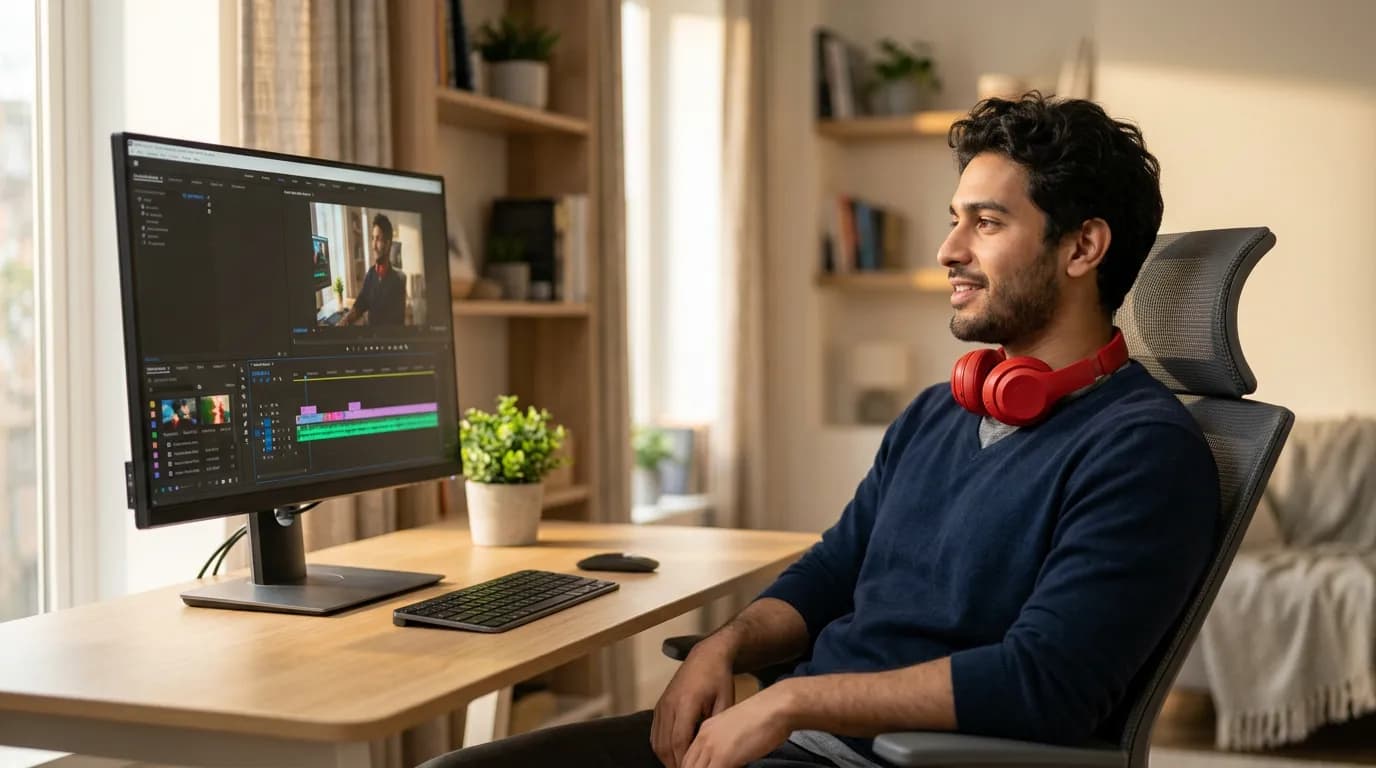
Video engagement rates crush image engagement rates
The data is not subtle. Video content generates 1200% more shares than text and image content combined, according to research across major social platforms. Instagram Reels get 22% more engagement than standard image posts. TikTok's entire growth story is built on video-first content. LinkedIn posts with video receive 5x more engagement than text posts.
Marketers know this. Every social media strategy deck in 2026 says "more video." The problem is not awareness. The problem is execution.
But video production intimidates most marketers
Video production feels like a completely different skill set. Filming requires equipment, lighting, and at minimum a decent smartphone setup. Editing requires software knowledge, timing instincts, and hours of post-production. Sound design, transitions, text animation, color grading, each adds another layer of complexity.
For a solo marketer or small team already stretched thin on static content, adding video production feels impossible. So they do not. They post static images and know they are leaving engagement on the table.
The result is a gap between what works and what most marketers can actually produce. Video wins on every metric, but the production barrier keeps most businesses stuck with static content.
You don't need video editing skills to create video content
Here is the shift: the definition of "video content" on social media has expanded far beyond traditional video production. You do not need cinematic footage, complex editing, or professional audio. What works on social media in 2026 is often far simpler than what marketers assume.
A product image with subtle motion, a gentle zoom, or a parallax effect counts as video content. Platforms treat it as video, serve it in video feeds, and give it the engagement boost that comes with motion content. You do not need Final Cut Pro to create this.
The barrier to video content has dropped dramatically. If you can create a good static image, you are already most of the way to creating video content that platforms reward.
What counts as "video" for social media
Social media platforms define video broadly. Any content with motion qualifies. This includes:
Full-motion video captured with a camera. Animated slideshows that cycle through multiple images. Static images with added motion effects like zoom, pan, or parallax. Product showcases that rotate or reveal from different angles. Before-and-after reveals with transition effects.
The most effective social media videos are often the simplest. A slow zoom on a product image. A gentle pan across a lifestyle scene. A quick sequence of three product angles. These require no filming, no editing timeline, and no audio engineering.
Reels, TikTok, Instagram Stories: format requirements
Each platform has specific format requirements for video content. Instagram Reels performs best at 1080x1920 vertical, 15-90 seconds. TikTok favors 1080x1920 vertical, 15-60 seconds for maximum reach. Instagram Stories need 1080x1920 vertical, up to 15 seconds per clip. Facebook Reels matches Instagram's specs.
The common thread is vertical format. If your images are already generated in vertical or square format, converting them to video content is straightforward. The motion layer, the part that makes it "video," is added on top of imagery you have already created.
How Adverra's video tools turn static images into motion
Adverra's video tools take your generated or uploaded static images and add professional motion. Animate Image is the quickest route: select your image, choose a motion style, and generate. Image to Video, First & Last Frame, and Ingredients to Video cover the cases where you want more control. The output is a video file ready for upload to any social platform.
Motion styles include slow zoom, which draws the viewer deeper into the image. Pan across, which works well for wide lifestyle scenes. Parallax, which creates a 3D depth effect from a 2D image. Ken Burns effect, the classic documentary-style slow zoom and pan.
Each style is optimized for social media engagement. The motion is subtle enough to feel professional, not gimmicky, but dynamic enough that platforms classify the content as video and serve it accordingly.
From 20 product images to 20 short videos in an afternoon
Here is the practical workflow. You have already generated 20 product images using Adverra's image tools. Now, select the top performers and batch them through Animate Image. Apply a slow zoom to your product shots. Add a pan across your lifestyle images. Create a sequence from your camera angle variations.
In an afternoon, your 20 static images become 20 short videos. Each video is formatted for social media, branded consistently, and ready to upload. No filming. No editing timeline. No audio engineering. No outsourcing.
The result is that your content calendar doubles in volume without doubling in effort. Every static image becomes both a post and a video post, covering both content types from a single generation session.
Repurposing generated images as video content
The smartest content strategy treats every image as the foundation for multiple content types. A product photo becomes an Instagram post, a Reel with motion, and a Story with a swipe-up. A lifestyle shot becomes a feed post, a TikTok with a parallax effect, and a Pinterest Pin.
This repurposing approach maximizes the value of every image you create. Instead of generating separate content for each platform and format, you generate high-quality images once and adapt them for every placement.
AI-generated images are particularly well-suited for this approach because they are already high resolution, properly composed, and brand-consistent. The foundation is solid, so every adaptation starts from a position of quality.
Publishing platforms and format optimization
Each publishing platform rewards slightly different video characteristics. Instagram Reels favors content that hooks in the first second. TikTok rewards content that holds attention through the full duration. Facebook prioritizes longer watch times. LinkedIn values professional production quality.
Optimize your video content for each platform's algorithm preferences. Use your most visually striking frame as the opening for Instagram. Keep TikTok videos shorter and more dynamic. Let Facebook videos breathe with slower, more atmospheric motion. Maintain polished transitions for LinkedIn.
The content is the same. The formatting and pacing adapt to each platform's preferences. This is the kind of optimization that used to require a dedicated video team. With AI-powered video creation, a single marketer handles it in an afternoon.